

The Organic Icon
Part II: Seeking Organicity in Our Parishes & Homes

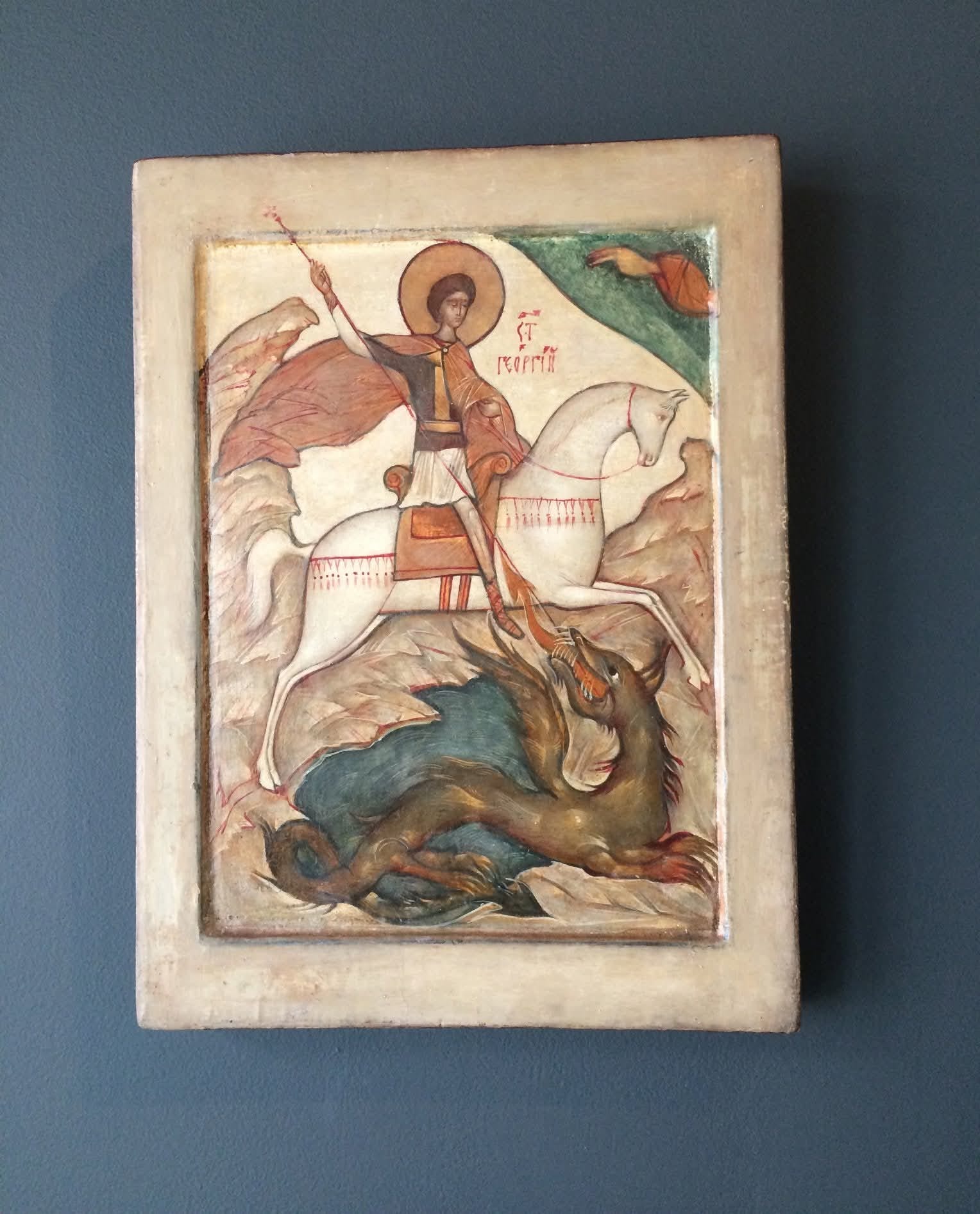
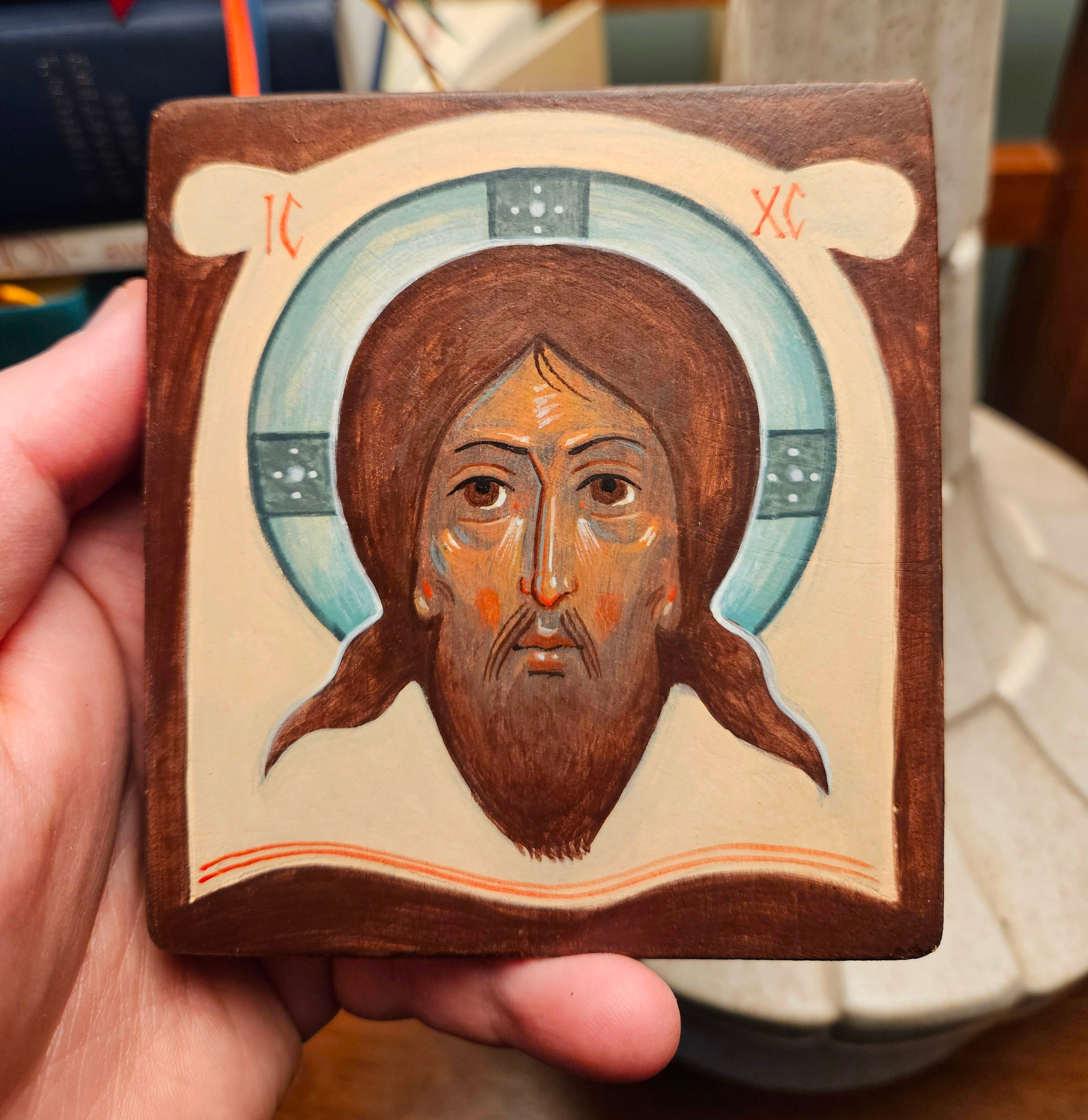
The previous article of this series ended with a call for churches to move away from the temptation to simulate or impose a foreign reality by using icon reproductions. I argued that what would make even our simplest mission parishes beautiful—and as a result attract more people—would be an intentional focus on the “human-to-human-to God connection” by using organic iconography, even if that meant not having more than two or three panel icons.
In order to make a case for prioritizing organicity in our parishes and homes, it would be helpful to take a brief look at Leonid Ouspensky, Fr Gregory Kroug, and the Brotherhood of St Photios.
Beauty Out of Chaos
Beauty is the way out, and beauty begins with God’s own work of art: humans.
The Brotherhood of St Photios1 played an important role in the life of the emigre Russian Orthodox in France that contributed to the formation of Patriarchal parishes in the country and clarifying the centrality of the Eucharist and the Divine Liturgy in the communal life of the Church during a time when the Russian community was split over the sophian heresy. But what is most important for us to consider is the way this Brotherhood, following the great suffering of Orthodox Christians under the Bolsheviks, decided to band together—though being minorities—and offer everything they had to make something beautiful out all that chaos.
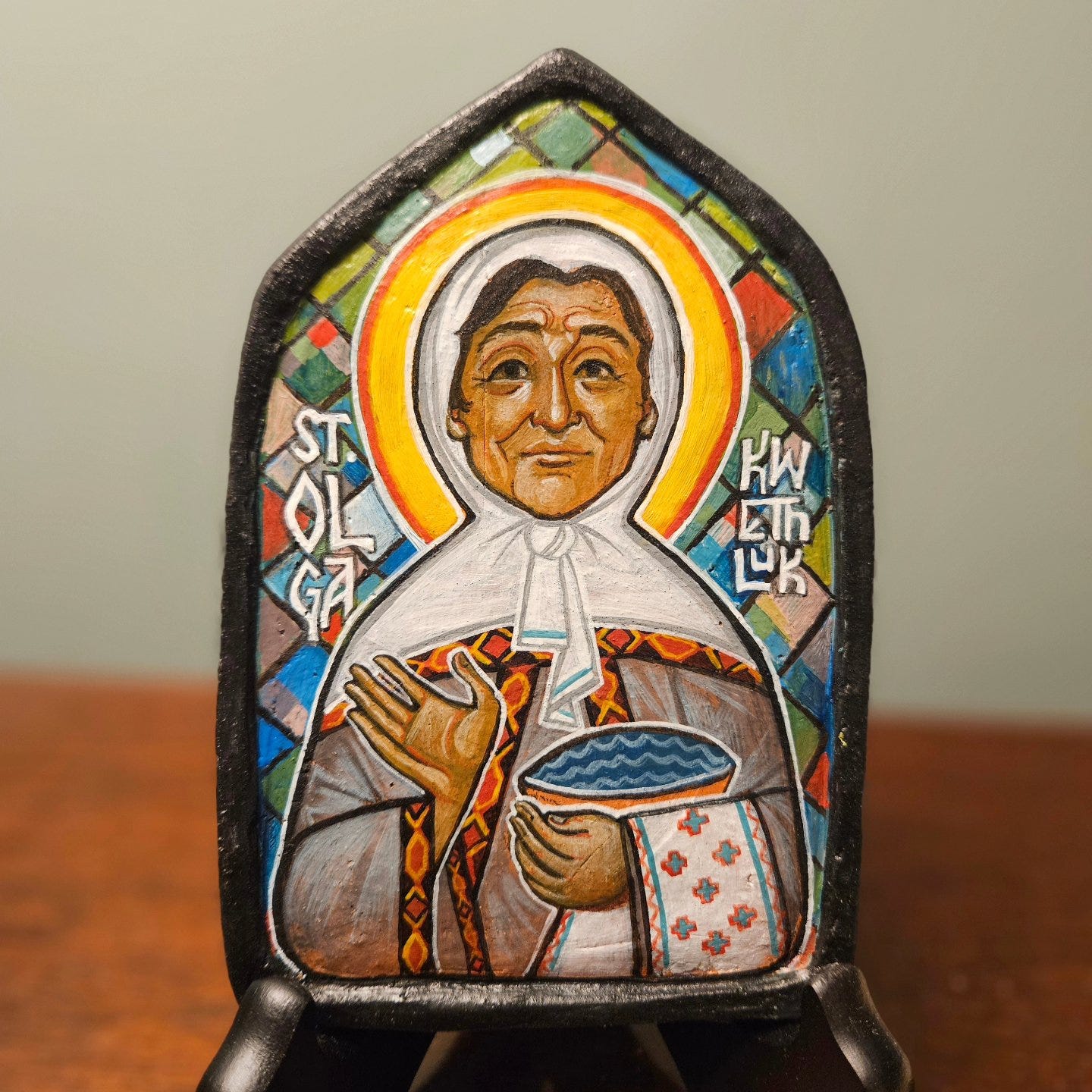
Ouspensky and Kroug, with the Brotherhood of St Photios, worked to articulate the Orthodox faith in and for their new context in the West. The challenge posed to them with iconography was their limited access to ancient models. As Seraphim O’Keefe explains in his article on Fr Gregory, Ouspensky and Kroug would search the Paris antique market for anything they could find and study them for hours. They were motivated to acquire whatever it is about icons that was speaking to them and healing them as well as those in their community.2 It was from this place they both painted—seeking the personal experience and encounter with Christ, for themselves and others, above all else.
These are the kinds of saintly folk who are being erased and discarded by the sham reproduction scheme. Fr Gregory worked in poverty, suffering much in his body, and yet was used by God to produce works that continue speaking to us today in an age of mass confusion and constant strife. Beauty is the way out, and beauty begins with God’s own work of art: humans.
Despite our frailty and constant struggle with our sins and thoughts, our own bodies are nevertheless the means by which God is saving us, and our neighbors, through repentance and faithfulness to Christ. Outsourcing the production of iconography to machines is in direct opposition to this creative movement of God to take us out of the chaotic, miry clay and form us into vessels of honor.3
The Medium is the Message
there would be no balm for the ears in a place absent of the sound of sacred harps
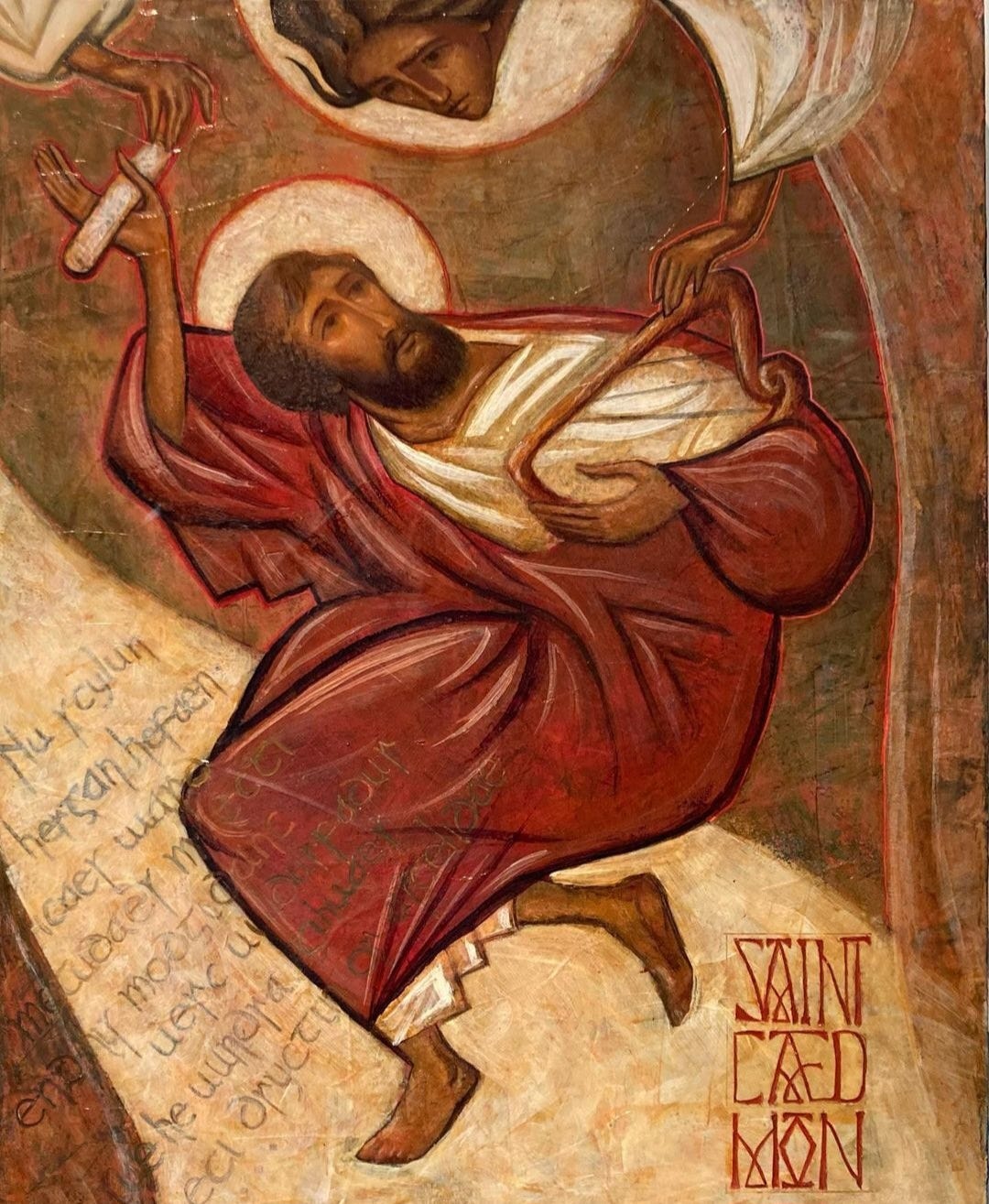
The local parish, as previously mentioned, is the first place where embracing God’s work of art begins. The Church receives her visitors and regular patients and offers the balm of Christ for their myriad ailments. But there is no balm for the eyes in a place covered in sham, just as there would be no balm for the ears in a place absent of the sound of sacred harps,4 and there would be no surgery for the heart without the preaching of the gospel. These, and more, all require the participation of the human work of art. If we would not dare outsource the priestly ministry nor the choir to even the highest fidelity recordings, we ought not dare do the same to the iconographer—and yet such daring behavior toward the iconographer has become the predominant habit.
The solution is simple: only buy organic icons from iconographers and only work with iconographers for the visual-liturgical needs of the local parish.
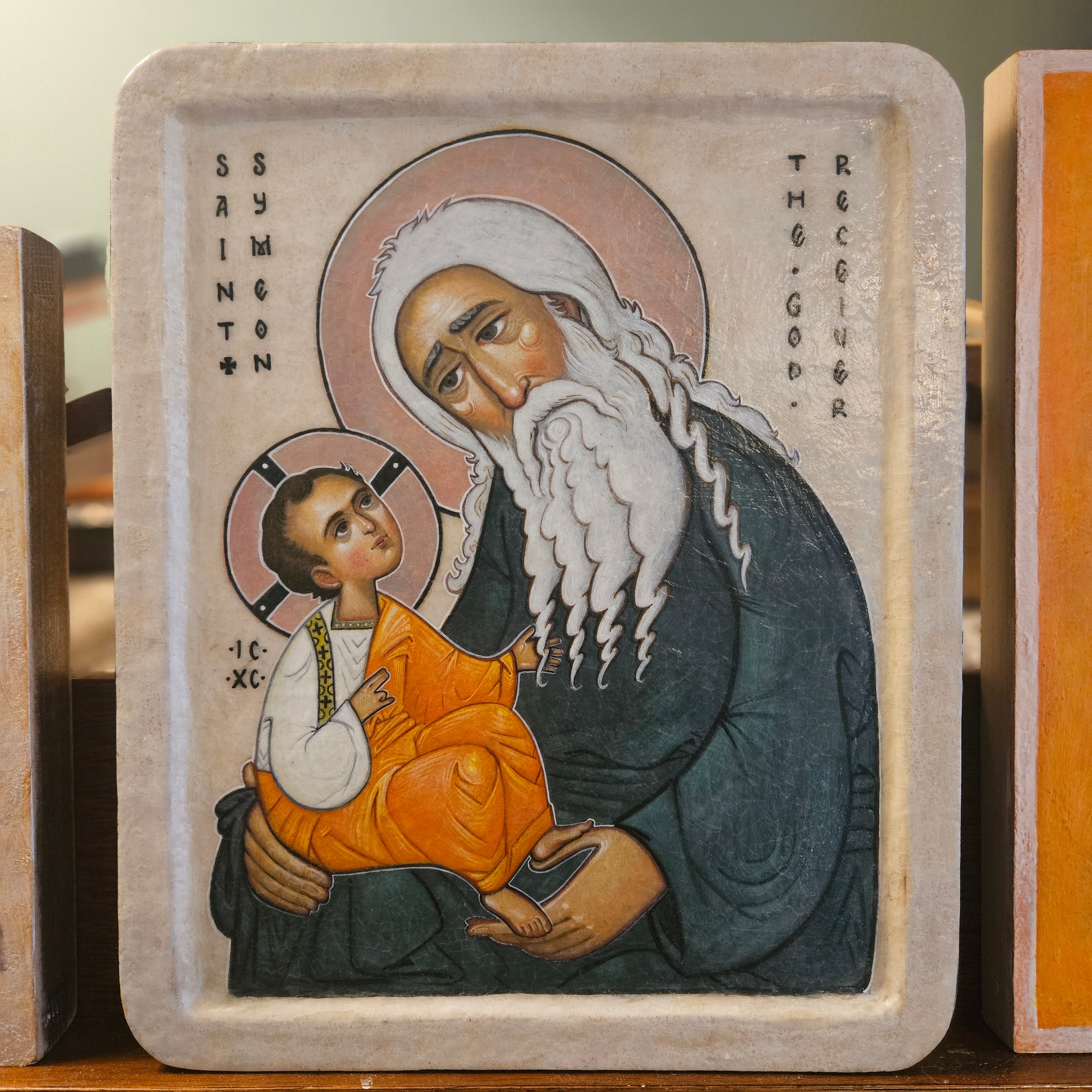
The same can be applied to the Orthodox Christian home: the little parish. As Orthodox Christians in America, we welcome all kinds of guests into our homes with all the same ailments that may or may not ever step foot into our churches. Although the home is distinct from the parish, it is nevertheless a place where people can encounter the Church through our hospitality. Besides the possibility of entertaining angels, there is also the possibility of others meeting Christ through us. Adorning our mantels—the place which should be the center of our homes—with organic images of our Lord, we are at the very least telegraphing that Christ is being experienced by people in the present. The inorganic sham, in contrast, telegraphs “Christian propaganda”—the opposite of a living culture. The medium is the message.5
Discerning Organicity
True organicity, true faith, is not content with imitating the Christian life.
An article published in a Moscow magazine on church aesthetics made its way into the Orthodox Arts Journal last summer. The author details an experience of a small, Swiss chapel built in the 18th century. As the author notes, there isn’t much that’s special about the architecture, decoration, or design. It’s quite plain with white, plaster walls, a wooden roof and small dome, and only two icons in a Baroque style. What struck the author was how this modest little church possessed the quality of organicity. That is, the entire design and presentation was quite intentional and served a specific purpose. There were no grandiose ideas of what this place could be, but instead a profound awareness of what it should be.
I suspect, with the author, that many modern parishes do not have much clue about what they should be in terms of aesthetics. The internet is largely to blame. Anyone brave enough (or dumb, like me) to venture into the Orthodox X/Twitter-verse has probably seen certain Orthodox guys posting “Go to church” replies with videos of elaborate and very imperial looking cathedrals—as though that’s where they are going to church. But for most Orthodox Christians in America, that whole idea of what an Orthodox Church is “supposed to look like” is not the reality. That idea of “what an Orthodox Church is supposed to look like” only exists in our imaginations, and is an image malformed by the information age. It’s religious theory, not faith.
The result of this theoretical approach to Orthodox aesthetics is to do things that seem Orthodox rather than just being Orthodox. You can discern the difference immediately: Buildings clearly modeled after Hagia Sophia or some other cathedral in Greece unnaturally settled next to rural trailer parks; digital replicas of painting programs of images designed for a foreign context adhered to the walls of buildings that were not designed to receive such images; and even (sadly) hand-painted programs that are ignorant of people and the space they occupy;6 etc.
True organicity, true faith, is not content with imitating the Christian life. True organicity and true faith can only be satisfied by actually living the way of Christ. Of course, we are all—especially in America—like children. We have to copy and imitate these new things in order to learn, and that is natural. What is unnatural is to never mature. There is a difference between becoming like a child to receive the Kingdom and refusing to set aside childish things to become a fully grown human.
Elder Thaddeus mentions something along these lines when speaking about prayer. It’s not enough, he says, to just say our prayers before our icons and then go about our business thinking, “Well done, well done!” as though checking it off our to-do list means true prayer has occurred. There is a point at which we must struggle for the prayers to become the very beating of our hearts and to move beyond merely copying what they say with our lips. We have to become prayer. We have to become Christ. This is organicity, and this quality is what our understanding of iconography ought to be.
A beautiful example of this is developing through Annunciation Orthodox Church in Rolla, Missouri. The parish, led by Fr Joel Wilson, has been collaborating with Andrew Gould to build a subdivided, walkable Orthodox village on some farmland they purchased in 2023. It is now 2026 and they’ve began the process of building a limestone bell tower and are continuing to dream about a large stone-built church for the future. In the meantime, they’ve been using their parish-hall as a temporary church. They’ve done all of this even after suffering some blows in their community that probably would have shut most places down.
Notice, too, the process of Annunciation Orthodox Church: (1) dreamed of what would make for a beautiful Orthodox community, (2) purchased land, (3) hired Orthodox architect to design, and then build, a parish hall/temporary church building,7 (4) hired same architect to design a monumental bell tower to stand at the crest of the hill on their land. This is a slow process. Some of the people there may not live to see it finished, but they work for the betterment of those who come after them. This is self-giving. It is opposed to immediate gratification—a passion the reproduction scheme feeds upon. One day they will have a church building and will need an iconographer. As they move toward that future, the people of that community will have their aesthetic blindness—inflicted upon them by the passions of the modern age—healed. Whoever is later in charge of finding an iconographer will not dare to abandon reality for sham. It won’t even enter their imagination. They will have been trained by their local Church to be like King David, seeking the beauty of the Lord and not resting until they’ve built a place to the glory of God with the best they could offer.
Answering Objections
Below are a few more objections commonly raised in protest to making an exclusive investment in the organic icon. I’ve given some answers with some suggested solutions.
Q: What about the poor and those who can’t afford organic icons?
A: My personal recommendation is for parish councils to create a designated fund to provide organic icons to every new convert who cannot afford an icon, or for any cradle Orthodox unable to afford an organic icon.
Many of the Orthodox iconographers working in the US are not monastics. They have the same needs as anyone else who lives in the world, especially those of us who have families. Although it would be ideal to work as Fr Gregory Kroug or St Alypius of the Kiev Caves, giving away our work with a disregard for the cost, the reality is that we are the ones footing the bill for all the supplies while also trying to provide for our families and competing against sanctified money machines (the icon printing scheme). We can’t be expected to work like monks. Understanding this, parish councils can play a monumental role in preserving Orthodox culture in the United States—honoring the faith that has been passed on to us—by supporting American Orthodox iconographers while also distributing organic icons to those who will venerate them.
Parishes could also work together to fund mural or panel icon projects for Orthodox ministries, such as homeless shelters that have chapels. I know many of us iconographers would love to be able to work with the assurance that our families will have their needs met while also getting to do beautiful work for suffering people.
But let’s also address the strange idea that lies beneath this objection. Does anyone know any impoverished person who is looking to purchase a $20-30 reproduction? I can’t say I’ve ever met such a person. It’s also really strange to expect the impoverished person who can’t afford a small hand-painted icon to go and spend the little money they have for a reproduction. Why not call upon a benefactor in the local parish to help such a person? It’s a slower road, but a better one. The impoverished person is given something truly beautiful, the iconographer and Orthodox tradition is supported in reality (rather than in theory), and the benefactor is given the gift of giving.
Let’s raise our expectations for our parishes and challenge those who have been financially gifted to support the Church in this way. Let’s raise our expectations for the beauty God can create within us.
This idea, of course, requires the cooperation of iconographers. We all work at various levels and have certain financial expectations. Those things don’t necessarily have to go away to make something like this work. A well-managed network of American iconographers could appeal to parishes of both humble and grand budgets by providing a database of iconographers with a general idea of the price of their work. Parish councils can select what works best for their needs from this database. They would also be able to contact iconographers to negotiate some kind of painting and payment strategy (especially for the parishes out there that are welcoming hundreds of new catechumens!). My challenge to my fellow iconographers would be to find/suggest collaborative opportunities.
Q: What about myrrh-streaming icons?
A: God condescends to His people under many circumstances because He loves us and is full of mercy and compassion. We have missed the plot if we think this phenomenon means the sham business of reproductions is equal to or greater than organic icons.
Q: Are you saying monks and nuns are wrong for making sham reproductions? What about Orthodox organizations that produces/resells them?
A: No. They’re being obedient to what they’ve been taught/given as work. I would hope that some of our financially gifted brothers and sisters would find suitable iconographers and pay them to teach our monks and nuns how to paint organic icons. This is obviously a long term goal, but a very modest proposition. I would hope for this to eventually displace the need for Orthodox organizations to produce/resell sham. It’s a long game, and we need to be conversing about this problem now in order to secure the future of Orthodox Christian culture in America.
Another excellent idea is for monasteries to produce and sell quality icon boards to iconographers. This work can also be done at multiple levels. Quality plywood is suitable for most of my own work, but others may want panels made more traditionally.
Monasteries and Orthodox organizations may also look into distributing painting pigments and supplies for iconographers. Although this would not be enough to disrupt the sham market, and would be a significant endeavor, it would be a major step in the right direction if marketed well.
Again, we have to think about the long game. The only immediate thing that can be done is for buyers to shift the market. Hold on to that $20-50 a little longer, build it up, and then come talk to me or find another iconographer you prefer. The more often parish councils and individuals do this, the less desirable/profitable it will be for the sham reproduction scheme to continue. Those businesses will have to change their priorities and adjust to the new market in order to provide something else of quality that cannot be provided by iconographers.
The most well-known figures of this Brotherhood are Vladimir Lossky, Leonid Ouspensky, and Fr Gregory Kroug. The works of the Lossky and Ouspensky are used in most, if not every, Orthodox seminary in the United States. Their works often had interior images and/or covers of icons pained by Fr Gregory.
Psalm 39/40 & Romans 9.21
Note that Ps 39/40 v.4 says, “He set into my mouth a new song, a hymn to our God”. The transformation—the conversion—of the human into God’s handiwork results in the human becoming a little creator that glorifies God with their being.
“The Sacred Harp” is the human voice. The term is commonly associated with traditional shape-note singing, which emphasizes the human voice, singing from the heart, as the harp that is pleasing to God’s ears.
I would once again remind readers that you should cherish the reproductions you have. All I am asking here is for consideration to be given to the effects of the medium on the human person. The medium of mechanical reproduction does not say, “this faith is alive”. The medium of human production does say, “this faith is alive”. Of course, this also is a subtle communication of our own values as well: “We prefer what is real as opposed to what is cheap”.
I would also add that this is why I’ve abandoned selling prints made with a digital medium. It is necessarily bound up with mechanical reproduction, despite the fact digital mediums require many of the same skills necessary for traditional art mediums.
I may write another time about the necessity for iconographers to acquire a pastoral sensitivity, though hopefully someone wiser than me will beat me to it. But the main thing to know is that organic iconicity does not stop at merely having hand-painted icons and murals—though that is the place to start. The truest expression of the organic icon is the icon that has been painted for the people of a particular time and context while nevertheless remaining faithful to the tradition of the Church. In other words, I am also opposed to the imposition of exclusively Greek or Russian schools upon American converts (or other ethnic groups). The Western school of the modern age for Orthodox Christians, in my opinion, belongs to the French school of Ouspensky and Fr Gregory Kroug, and should be the starting place for American iconographers.
It was designed with numerous windows and large doors to allow the space to open up much more with beautiful weather.