

The Organic Icon
Part I: Exhorting Exclusive Investment in Hand-Painted Iconography

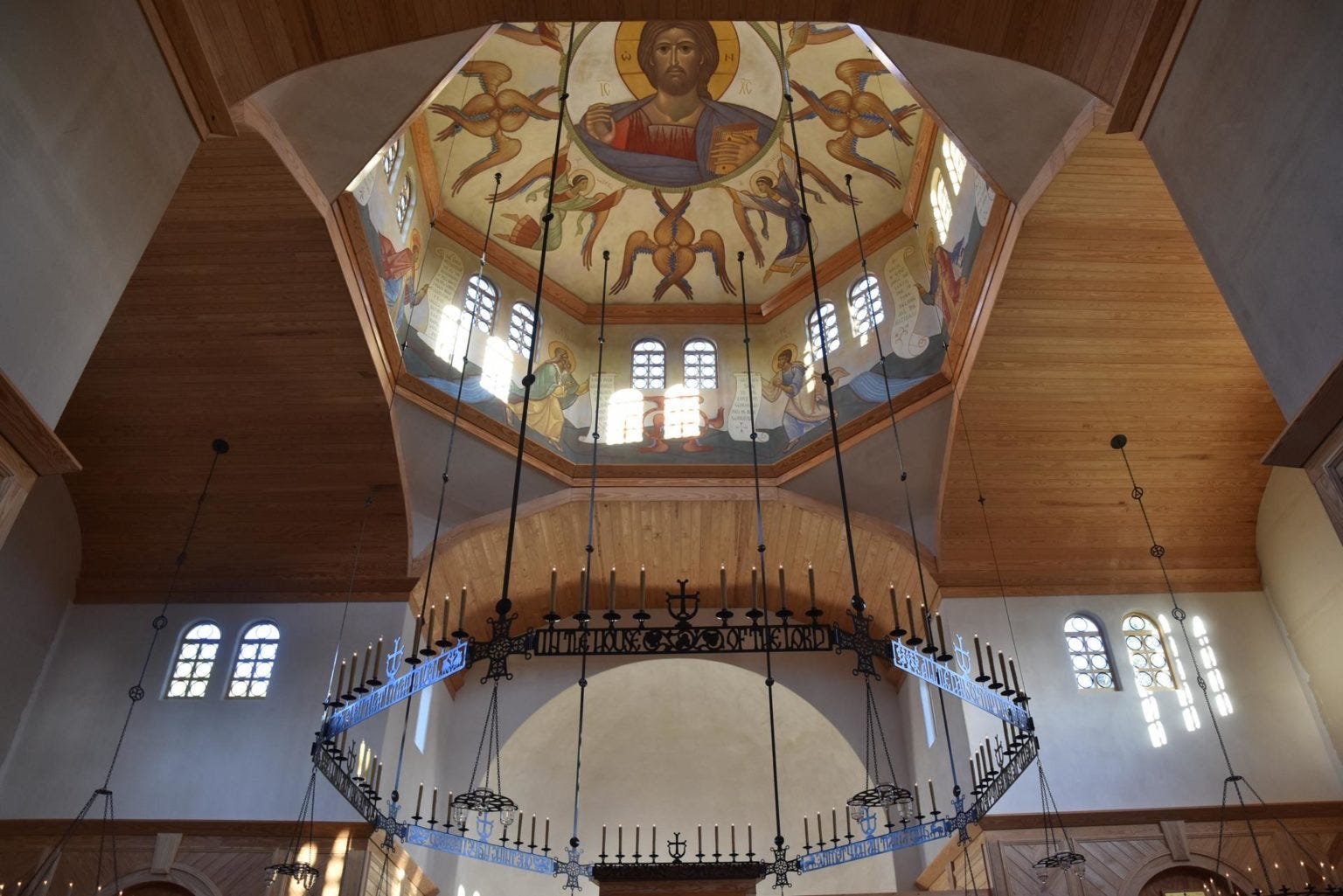
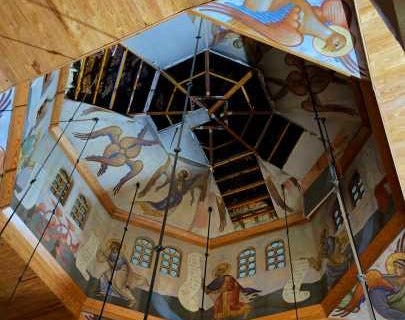
St John of the Ladder in Greenville, SC (OCA) recently caught fire after the dome was struck by lightning. The fire department quickly put out the fire and saved the building from further damage. However, the fire and water damage caused the Pantocrator icon in the dome to come crashing down.
Seraphim O’Keefe, my godfather, is the iconographer at St John of the Ladder. I recently visited the parish to catch-up with him, and I had a wonderful encounter with a man who came to speak with him as well. This man was on the verge of tears as he embraced Seraphim and expressed sorrow for what happened to his work. After we exchanged names and began to chat, this man shared that he came to know Christ through this particular icon and that his salvation had first began to be experienced through his encounter with that image.
These kinds of childlike encounters with Christ through the skilled labor of iconographers is the primary reason I’m encouraging and exhorting my brothers and sisters in the Orthodox Church to exclusively invest in hand-painted icons and murals.
The icon is a work of liturgical art created by humans in the service and love of God and the saints. The theology of the icon could be most succinctly summarized as the experience of the incarnate Christ (the Prototype) through His image (which subsists in the Prototype).1 Because the icon is a work of liturgical art, this naturally means that it belongs exclusively to the work of the people of Christ’s body.
The Church used to gather in the catacombs and yet they made these dark spaces as bright as heaven. They were constrained to particular places and yet transformed those limited boundaries through the limitless potential of God’s grace.
St Theodore the Studite said that “Christ’s image becomes more conspicuous to all when it appears by imprinting itself in materials.”2 There was no mechanical reproduction of icons at this time, and the understanding of St Theodore was that Christ’s image is self-imprinted on the painted icon through the iconographer’s materials. By what means was Christ’s image self-imprinted into materials? The human hand. I do not think it’s even remotely a stretch to conclude that there is a cooperation, a synergy, of God and man in the skilled production of icons. Outsourcing the ministry that was given to us by God through the incarnation of Jesus Christ to machines is like turning away from the good gift of a father. The Church’s support of living iconographers is a reception and reciprocation of God’s love. The human painting of icons is the best means of producing icons. It is by this means, specifically, that Christ’s image is most clearly visible to everyone.
When I write of the organic icon, this is what I mean. By implication, that means anything short of this is inorganic and mechanical sham.
This implication sometimes makes people uncomfortable or angry. Many of us probably have some sentimental attachments to reproductions we purchase after converting, gifts of icon reproductions given to us by loved ones, or icons purchased as souvenirs from pilgrimages. Cherish those images. I’m not telling anyone they should toss them out. What I am saying is to stop buying them and that Orthodox Christians need to begin phasing out the mechanical reproduction scheme in all its forms.3
My view on this subject invites many questions from readers. The rest of this article, and this series, will address those commonly asked questions. I’m also proposing a number of solutions across this series to demonstrate that it’s not an impossible situation. We are addicted to our capitalism and marketing schemes, getting whatever we want as quickly and as cheaply as possible, and this addiction will only contribute to the decline of the already relatively small number of American iconographers. Failure to address this addiction will also constitute a failure to support the future of Orthodox Christianity in the United States.
Q: “I have icons blessed by _____, surely this means they’re valid and worthy of veneration.”
A: There are four necessary responses to this statement:
The blessing of icons is a foreign and non-apostolic practice,
the rite for the so-called blessing of icons is rooted in an iconoclast argument,
icons, whether organic or sham reproduction, cannot have their blessedness increased nor decreased by the holiness of a person who has applied a rite of blessing or venerated that icon (which is a subtle Donatism),4
and icons are inherently venerable by nature of what they are as images of prototypes.
Most of these points are fully explained in Fr Steven Bigham’s article on the Orthodox Arts Journal from 2012, but I will expand a bit on points three and four:
Donatism was a schismatic heresy between the 4th and 6th centuries which argued that sacramental and ministerial efficacy can be nullified by a cleric’s sins. St Augustine combated this heresy by rightly arguing that the efficacy of the sacraments and priestly ministry is independent of the personal character of the cleric. Rather, it is Christ Himself, as Thomas Aquinas also taught in the Summa, who confers grace through the sacraments of the Church. This naturally means that the inverse is true as well: sacramental and ministerial efficacy cannot be increased by the holiness of a cleric.5
Although appealing to our sentiments, it’s simply not true that a holy person using the foreign rite of blessing icons—whether of organic or mechanical reproduction—has contributed anything to the icon’s sanctity or validity. This is not to say it wouldn’t be special to own an icon venerated by someone we revere. But that sentimentality should not be conflated with the nature of the icon. Icons are already blessed because they bear the likeness and name of their prototypes and therefore are inherently venerable.
Q: My parish is covered in sham wallpaper and mechanical reproductions—what should I do?
A: Venerate the images. Although true that these are less worthy responses to the love of God (namely because their continued production hurts iconographers), not to mention degradations of their originals and of the experience of their prototypes, they are still icons.
“From the simultaneous existence of both [image & Prototype], it follows that when Christ is seen, then His image is also potentially seen, and consequently is transferred by imprint into any material whatever.”
“… when one considers the likeness to the original [Prototype] by means of a representation, it is both Christ and the image of Christ. It is Christ by the identity of name, but the image of Christ by its relationship. For the copy is a copy of its original, just as a name is the name of that which is named.”
“… [and] the copy is called like the original by identity of name.”
~St Theodore the Studite, On the Holy Icons6
Based on St Theodore’s words, we can say it’s true that Christ’s image, and thus access to Him, remains intact even through mechanical/sham reproduction. Yet we must also say that the copy [reproduction] of the copy [icon] of the original [the Prototype], though remaining truly the image of Christ, is a degradation of the holy image of our Lord. These are both at once true things.
How is it that I can say the reproduction is a degradation? Because reproductions make the human-to-human-to-God connection inaccessible. Deep calls to deep. We are amazed by the labor and skill of iconographers because their bodies have acquired a skill that is exceedingly difficult for the majority of people to acquire. Beneath that amazement at human creativity lies our wonder and devotion to the Creator. But reproductions flatten out and remove every indication of human labor that is experienced through organic iconography. We cannot properly be in wonder and awe of God through simulations of human work. Reproductions are anemic and impoverished for liturgical use because liturgy requires the cooperation of human and divine energy.
Consider the greatest commandment:
“Hear, O Israel, the Lord our God is one Lord: And you shall love the Lord your God with all your heart, and with all your soul, and with all your mind, and with all your strength: this is the first commandment. And the second is like, namely this, you shall love your neighbor as yourself. There is no other commandment greater than these.”7
The “human-to-human-to-God connection” is essential. What we have in reproductions, on the other hand, is a “human-to-machine-to-God connection”. This connection does not work so well. Deep does not call to shallow.
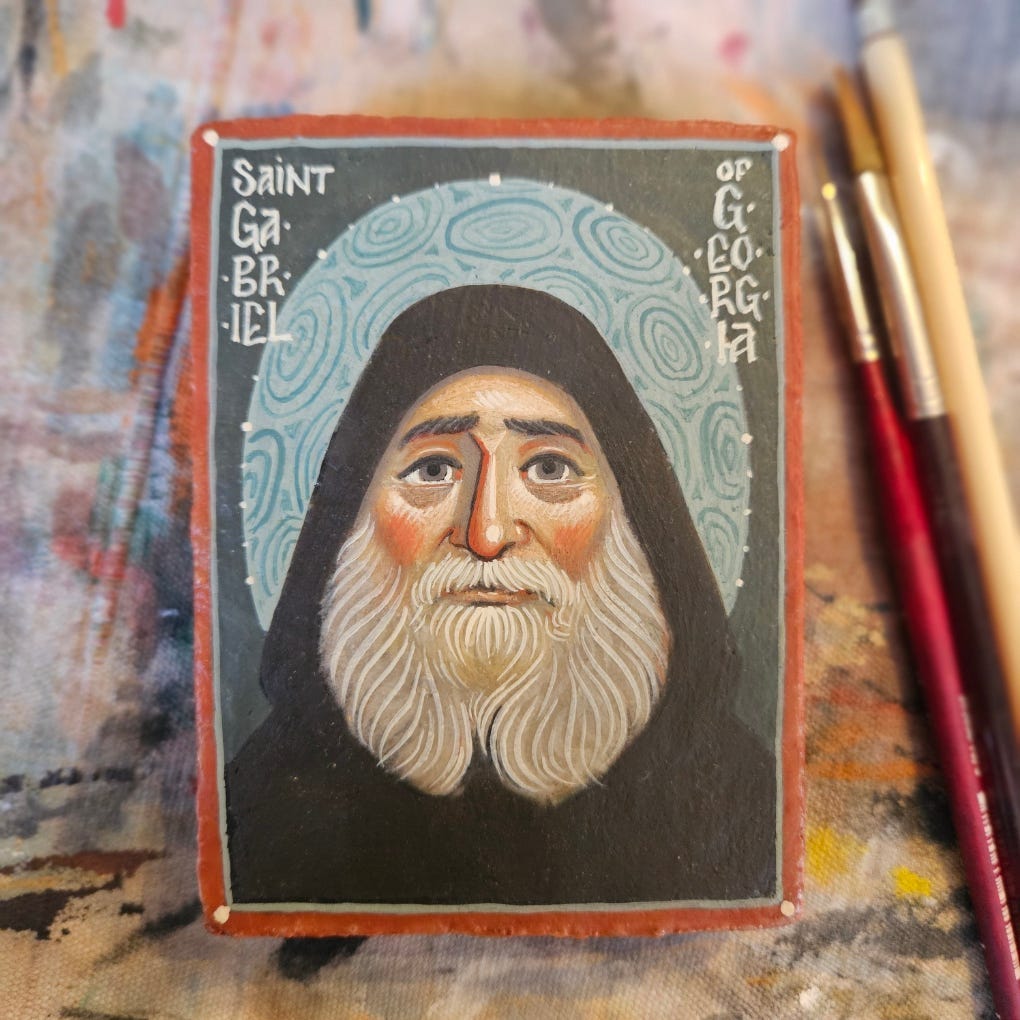
I’ve written before about St Gabriel of Georgia. One of the stories about him is that he would rescue images from magazines in which those images were mocked. He would fashion frames for them out of other discarded materials and adorn his little chapel with them. Following his example to the fullest would mean we’ve kissed our phones or computers as we’ve seen each icon cross the screen. I’m guessing you didn’t do that—neither did I—and that’s the problem.
We don’t benefit from icons by treating them like Pokémon (gotta catch all the saints), nor by treating them as souvenirs, nor by treating them as social status symbols (“Hey, I’m Orthodox now, check out my based icon collection!”), nor by treating them as propaganda. Perhaps this view could be associated with someone like Paul Kingsnorth at this point. A more ideal, future scenario is for us to live in a radically less image-saturated culture. We are distracted and disoriented by an overwhelming abundance of images, and we increase this distraction and disorientation within ourselves by investing in and proliferating sham.
The Church’s support of living iconographers is a reception and reciprocation of God’s love. The human painting of icons is the best means of producing icons. It is by this means, specifically, that Christ’s image is most clearly visible to everyone.
The Church used to gather in the catacombs and yet they made these dark spaces as bright as heaven. They were constrained to particular places and yet transformed those limited boundaries through the limitless potential of God’s grace. Many of us Orthodox Christians in the US are constrained to storefronts and modular means of gathering. This means that most of us won’t be worshiping in grand cathedrals. The solution is not sham wallpaper or covering the walls in as many replicas as possible. This would result in the poor simulation of a foreign reality. What will make these spaces beautiful—and as a result, attract more people—is an intentional focus on the human-to-human-to-God connection by exclusively using hand painted icons. If all the parish can afford are two-three panels, do that. If the parish grows and can afford million-dollar murals, do that. This connection is the surest way to God.8
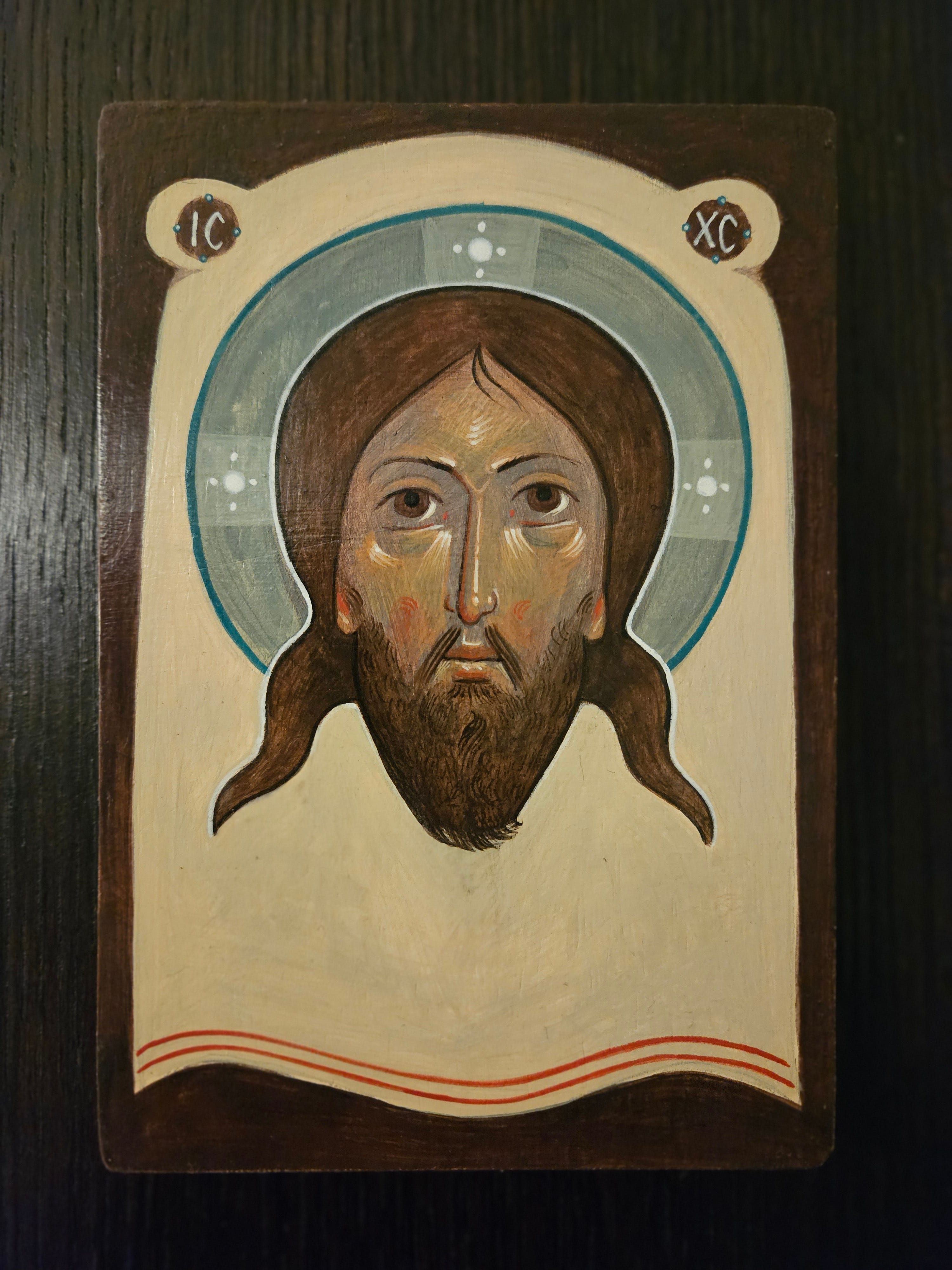
Please use the link below to share this article if you enjoyed the read and would like for others to support my work. If you’re not subscribed already, this is your invitation! You may also consider upgrading your subscription if you’d like discounts on commissions or to get a hand-painted Mandylion (Founding Member tier). Thank you so much for your support!
“If every body is inseparably followed by its own shadow, and no one in his right mind could say that a body is shadowless, but rather we can see in the body the shadow which follows, and in the shadow the body which precedes: thus no one could say that Christ is imageless, if indeed He has a body with its characteristic form, but rather we can see in Christ His image existing by implication and in the image Christ plainly visible as its prototype.”
For anyone who doesn’t know what is meant by “Prototype”, this just means the original after which something is modeled. Christ is the original and the icon is modeled after Him, but also the image already exists in the Prototype. Christ and His image are paradoxically interdependent.
St Theodore the Studite, On the Holy Icons, ed. John Behr, trans. Catharine P. Roth, vol. 6, Popular Patristics Series (Crestwood, NY: St Vladimir’s Seminary Press, 1981), 109.
Ibid., 113.
I took my own first step by taking down every option for purchasing my digital prints and reproductions of my hand painted icons.
For the sake a clarity, I must state emphatically that I am not calling anyone and everyone who has ever performed this foreign rite a heretic.
See, for example, the first controversy mentioned in St Paul’s letter to the Corinthians. Christians were blocking access to Christ by making up a social caste system. Those who identified as following Paul were less than those who followed Apollos, and those who followed them were less than those who followed Peter, and those who followed Peter were less than those who followed Christ. The basis of the divisions was the figure who baptized them. St Paul counters this divisiveness by teaching that they are all one in Christ and that no one person is greater than another because they are all together in Christ.
St Theodore the Studite, On the Holy Icons, 109 & 32.
Mark 12.29-31, emphasis added.
You could also give away all the reproductions to folks who don’t have any and commit to saving money to hire an iconographer to fill your space.
Amen to all that! Well said, brother. Alas, we are so far away from that ideal… but it’s a start. 🙏