


The holy prophet Elijah appeared in a time great spiritual depravity, especially among the kings who betrayed their calling to be images of the One True King. Ahab, the son of Omri, began to rule in Israel and was more wicked than his father and all the kings that came before him. The Scriptures say that walking in the sins of Jeroboam was an easy thing for Ahab (1 Kings 16.30-33), and yet he dared to call the prophet Elijah “the troubler of Israel” (1 Kings 18.17). There was no self-awareness of his sin nor knowledge of God. All of Israel’s troubles were because of their leaders turning them away from the worship and service of God to the worship and service of Baal.1
Ahab is not the only villain of the story. There is also his wife, Jezebel. I find it important to note that both Ahab and Jezebel are problems, and that it wasn’t Jezebel who corrupted Ahab. Sometimes Jezebel gets co-opted by those who want to blame women for everything, as well as by those who want to blame men for everything. They were both problems.
The Law is clear that neither Ahab, nor any Jew, was to marry an outsider. Ahab was not at all concerned with maintaining ritual purity and couldn’t care less about the moral influence of Jezebel—who explicitly and purposefully served and worshiped Baal.
Baal was not a random pagan god. Baal is the satan figure seeking to destroy the people of God throughout much of the Old Testament. Careful readers may have noticed that the serpent seems to disappear after the Genesis narrative. We know this serpent is the satan—the devil—who tempted Job, for example, and there are a few other examples of this obvious kind of appearance.2 But we otherwise hear mostly about Israel’s betrayal of Yahweh for the worship of false gods—especially Baal.
The story of Elijah is foreshadowing the New Testament story of St John the Forerunner confronting Herod’s illegitimate marriage to Herodias. The daughter of Herodias, Salome, was Herod’s niece. She danced provocatively in the court and pleased Herod. The perverse nature of this is quite clear considering Herod offered Salome up to half of his kingdom. This is the kind of wickedness that also characterized Ahab and Jezebel.
An excerpt from St Ephrem’s Commentary:
Exactly at the time when the prophet and father of the prophets Elijah appeared, the rebellion of Ahab and his wife Jezebel had increased to such an extent that they not only trampled the law and fear of God underfoot, nor were content to promote the worship of idols, but even persecuted and killed the prophets and the saints.
Moses wrote a large book of curses and ordered Joshua to proclaim them before the assembly of all the tribes of Israel with great clamor and loudly. He especially mentions the harsh famine and the other evils that follow it, the deprivation of the rain, the aridity and infertility of the land. Ahab despised and laughed at them, because he saw how abundant his supplies were, thanks to his father who was an impious king like him. Therefore, that arrogant king necessarily had to be punished for his arrogance. But the main reason why Elijah was sent was Jezebel, whose pride the Lord wanted to humiliate and whose falsehood he wanted to disclose. She had actually appointed herself as minister of Baal and had entrusted herself with the religious service for this god. She also proclaimed that Baal was the supreme god who ruled over those living in heaven and on earth and sent rain, watered the skies and gave fertility to the ground. She took as witnesses her fellow citizens, the Sidonians and the Tyrians and the other peoples of Phoenicia who were prosperous in those days in wealth and possessions more than any other of the neighboring nations and were also the most fervent worshipers of Baal. It was with good reason and according to justice that Elijah rose and came at that time of distress, and finally issued a stern rebuke against Ahab and his leaders and threatened to bring on them a sky of iron, as Moses had predicted, and a land of bronze.
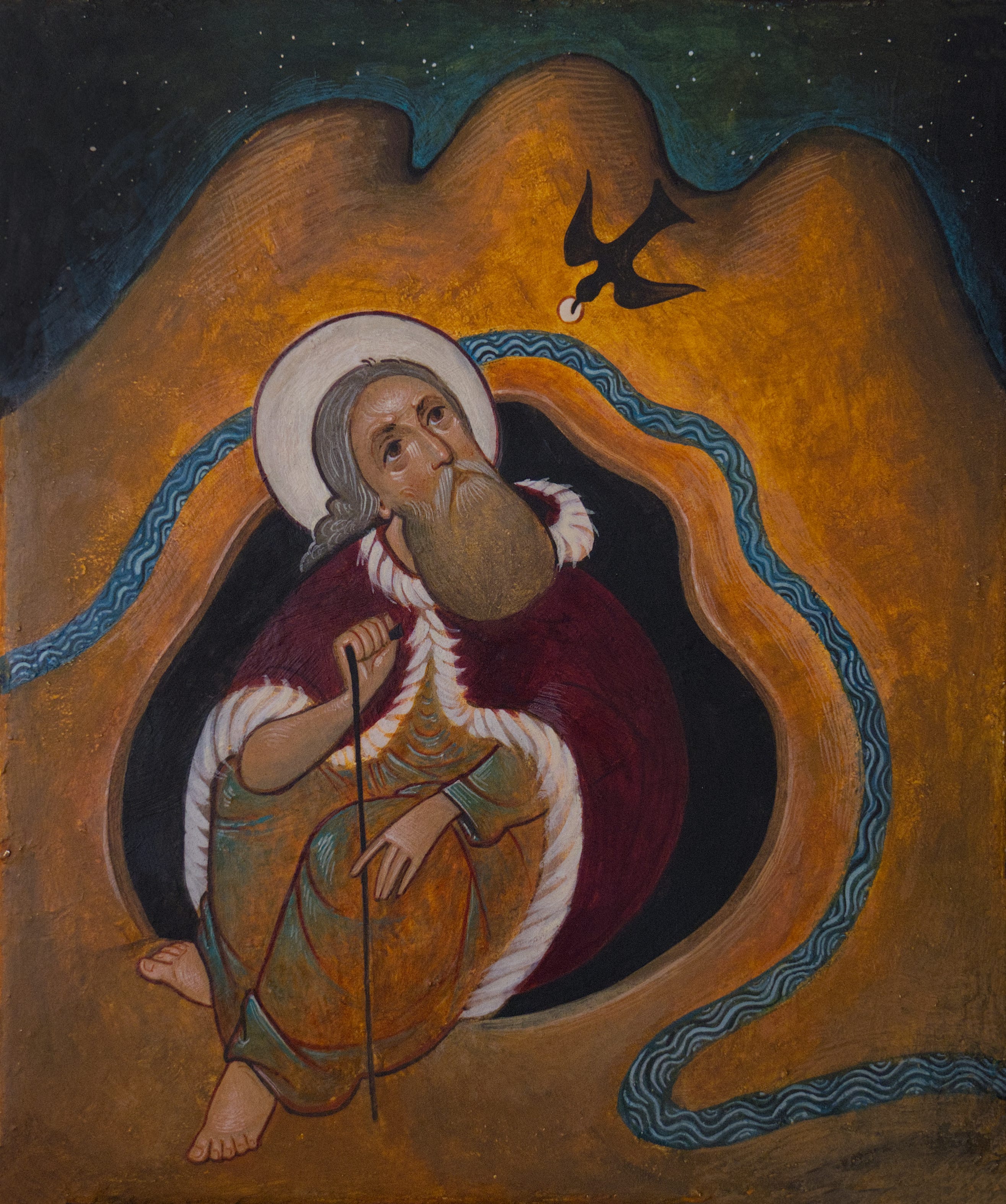
The Logos of God appears to the Prophet Elijah and tell him to go East and hide near the brook of Cherith which flows from the Jordan. It is in the Jordan that our Lord was baptized. The lore of the Prophet is woven together with that of his Lord. Their lives become as one. It is as though the Great Shepherd led the prophet to be nourished by the waters of His baptism.3
There, in that Eastern land of light, ravens from Zion brought Elijah bread to give him the strength of God in the morning, filling him with justice and stability and wisdom. These ravens return with the prefigural meat of Christ in the evening, assuring the prophet that the Light will arise, clothed in the flesh of humanity, to dispel the darkness of injustice and sin and death and nourish the hungry with good things.4
The Lord prepared His prophet a bountiful table in the presence of his enemies—the enemies of Elijah and the enemies of God. Elijah was there nourished by Christ Himself.
Great Lent is quickly approaching. If you’re reading this, you probably do are not in conflict with a modern, political equivalent to Ahab and Jezebel. But I would wager that, like me, you’re afflicted by the same demonic spirits behind such figures. Christ is calling us to the wilderness where we will be nourished by the food only He can give. There is no worldly food available to us in that place—no milk, no juicy steaks and bacon. But we will surely be satisfied with good things. With the water of the Spirit. With the body and blood of Christ. With the love of the Father.
This is not to say individuals were not responsible for participating in what their leaders were telling them to do. They are, of course. But leaders are held to a higher standard. Luke 17.1-3
Another example would be the episode with the Prophet Micaiah and “the lying spirit”. Perhaps even less known is the demon Azazel, who appears in Enoch and Tobit, and he is also the satan.
This is the interpretation given by St Ephrem the Syrian. The stream/brook prefigures “the stream flowing from the sanctuary” which is the Incarnate Christ. It is also the healing stream of Christ’s baptism.
Isaiah 33 and additional references drawn from St Ephrem’s commentary.
Holy Prophet of God Saint Elijah the Tishbite, please pray for us! ⛰️🔥🗡️🌦️🐎🪽✨